
So, I haven’t written anything for a while.
I’ve been a bit out of sorts, I guess you could say. River starting his new unit has taken more out of me than I expected. Maybe I find transitions difficult too.
Over the last month, everything has started to feel a bit much. I’ve found it harder to focus on the positives and increasingly difficult to switch my brain off.
I went along to my local support group recently and came away feeling completely drained and, actually, quite sad. There was so much frustration and anger in the room. Understandably so. Everyone needs somewhere to vent, share their experiences and feel heard. That’s why the group exists.
But I’ve realised that perhaps it’s not what I need right now.
I’ve never particularly liked feeling angry. I tend to use humour to diffuse uncomfortable situations or, if that fails, remove myself completely. It’s not necessarily the healthiest coping mechanism, but it’s mine.
And lately, I feel like I’m surrounded by stories about children struggling, parents fighting and systems failing. Some of those stories are mine, some belong to people I’ve met, and some are things I’ve read online. Individually, they’re important. Collectively, they’re becoming quite overwhelming.
One very small step
Starting every morning with crying and protests has been tough.
Asking River how his day was and hearing, “It was bad. You weren’t there. I waited for you,” is heartbreaking.
There’s also the constant second-guessing. Am I doing the right thing? Am I pushing too hard? Not hard enough? Should I be doing something completely different?
For the last two weeks, our main aim has been to get River to visit his mainstream classroom.
His teacher tried. His previous one-to-one tried. Other teachers tried.
Absolutely not.
I tried talking to him about it at home, but he screamed and cried as though I was physically hurting him.
His safe person at after-school club even tried walking him past the classroom. More screaming, more crying.
Eventually, it was suggested that I try.
I wasn’t entirely convinced. I’m not going to be there during the school day, so I didn’t really want him associating the classroom with needing me. But we were running out of ideas.
So, this week, I collected him a little earlier and we went to have a look.
He clung to the doorframe as though he was being sucked out of an aircraft, begging me not to go inside.
The classroom was empty. Silent. Everything was tidy and organised.
I gently prised his fingers off the frame, sat down on the carpet with him in my arms and produced the magic Quavers from my bag.
We sat there rocking quietly for about five minutes.
Then he started humming.
Little by little, he began looking around. He read the visual timetable on the wall, met his teacher (who was clearly trying to go home!) and found his name.
He even walked a few steps away from me.
Then he announced it was time to leave.
And that was that.
He hasn’t managed to go back independently yet, but he no longer screams when we mention the classroom.
Another tiny step. And right now, tiny steps are everything.
Is it autism, or is something else going on?
I also took River to the doctor this week.
I’ve mentioned before that his stimming has gone into overdrive, and it hasn’t really calmed down. He’s jumping, flapping, making unusual facial movements and sometimes seems to zone out completely.
The doctor was lovely.
I explained that I know he’s autistic. I’m not trying to stop him being autistic. I just don’t want to miss something because we assume every change in his behaviour must be connected to his diagnosis.
If Summer’s behaviour changed dramatically over a few weeks and she started zoning out and not responding, I’d be straight down to A&E.
Why should River be any different?
We got a referral, so I’m sure I’ll see someone in approximately a year, be told it’s his autism and get discharged again.
I’m joking. Sort of.
But at least it’s been documented, and hopefully we can start identifying patterns and ruling things out.
Apparently, we have eight senses
This week, I also attended a course to become an Occupational Therapy Champion at school.
This essentially means learning more about occupational therapy, sharing recommendations with staff and helping them put strategies into practice.
I thoroughly enjoyed it.
I also realised just how enormous the subject is and how quickly you can disappear down another rabbit hole.
For example, did you know we have eight senses?
Not just the five we all know and love. There are three more, and they’re particularly interesting when it comes to understanding sensory differences.
Vestibular sense, is our sense of balance and movement. It helps us understand where our head and body are in relation to gravity, and whether we’re moving, spinning or staying still.
Proprioception, is our sense of body position. It tells us where our arms, legs and other body parts are without having to look at them. It’s also involved in understanding how much force we’re using.
Interoception, is our awareness of what’s happening inside our bodies. Hunger, thirst, temperature, needing the toilet, our heartbeat and other internal signals.
I’d heard bits about these before, but learning more about them has helped me start making sense of some of River’s behaviours.
And this is where it gets complicated.
Imagine trying to work out which of eight different senses might be affecting someone at any given moment.
Is it a smell? A sound? A texture? The lighting? Are they hungry? Too hot? Do they need movement? Does their body feel uncomfortable?
Now imagine trying to work that out for someone who can’t always explain what they’re experiencing.
River is an incredibly sensitive little boy, and he seems to be affected by quite a few of his senses.
Food, for example, has to be cold. Not hot. Not warm. Cold.
He finds hunger and thirst particularly difficult to tolerate.
He loves physical contact, but often prefers firm pressure or extreme closeness. Think cheek-to-cheek, with absolutely no personal space whatsoever.
His jumping, spinning and flapping may be helping him regulate his vestibular and proprioceptive systems. Movement might be giving his body sensory information that he needs.
Of course, I can’t know exactly what he’s experiencing, but little by little I’m beginning to understand more.
And the important thing is that I’m not learning all this to train these behaviours out of him.
I’m learning so I can understand what makes him uncomfortable, what helps him feel safe and how I can make his world a little easier to navigate.
We wouldn’t tell someone with a nut allergy to just get over it and keep eating nuts until they got used to them.
Yet we sometimes expect children with sensory difficulties to simply tolerate things that cause them genuine distress.
The more I learn, the more I realise how much I don’t know.
Which is fascinating.
And exhausting.
SEND is big business

Naturally, after spending the week learning about sensory processing, I decided what I really needed was to spend my Saturday thinking about SEND some more.
I know how to have a good time.
Off I went to North London for the TES SEND Show.
I arrived, collected my lanyard and entered the exhibition.
I wasn’t entirely sure what to expect. I’ve been to home shows and food exhibitions before, so I knew there would be stalls and products, but I wasn’t sure how that would translate to SEND.
Well, apparently, exactly the same way.
SEND is big business.
Sensory equipment, learning aids, specialist furniture, online platforms and enough educational apps to keep every child staring at a screen until retirement.
If there’s a difficulty, there’s apparently a product to solve it. Usually with a rather impressive price tag.
I wandered around some of the sensory stalls and was genuinely amazed to discover that what appeared to be a dark tent could cost over £2,000.
Two thousand pounds!
There were lots of smiling people keen to ask about my role in school. I began to suspect that what they really wanted to know was whether I had access to a budget.
And then there were the screens.
We’re constantly hearing about the dangers of screen time and how children spend too much time looking at devices.
Unless, apparently, it’s an educational screen.
Then it’s revolutionary.
I don’t doubt that some of these products are genuinely useful. I’m sure some make an enormous difference to individual children.
But I couldn’t help wondering how much of this money might be better spent on the people actually supporting them.
More staff. Better training. Smaller groups. Time to plan and implement the strategies we’re constantly being told about.
None of which looks particularly exciting on an exhibition stand.
Telling children to ‘just get ready’
I decided to escape the sales pitches and head to a lecture I’d paid to attend about executive functioning and the difficulties it can cause in the classroom.
The speaker was excellent. Engaging, knowledgeable, and I even managed to keep up with most of the science.
Executive functioning is essentially the set of mental skills that help us plan, organise, remember instructions, manage our attention and complete tasks.
One of the things discussed was how these skills develop at different rates throughout childhood and adolescence, continuing to mature into early adulthood.
Children of the same age can have very different executive functioning abilities.
Which makes our favourite adult phrase, “You’re old enough now, you should be able to do that,” rather less helpful than we’d like to think.
The speaker used the example of going shopping.
Most of us wouldn’t just turn up at the supermarket and hope for the best. We’d think about what we needed, perhaps make a list, check what we already had and work out how to get everything done.
We use tools to support our executive functioning all the time, often without even realising it.
Now think about a child in the classroom.
They’re given a task, perhaps with a vocabulary sheet and some sentence starters, but they don’t know where to begin.
We’ve provided the resources, but have we actually taught them how to use them?
For some children, the task needs breaking down into much smaller steps. They need to be shown how to start, what to do next and how to recognise when they’ve finished.
And it’s not just children with SEND who benefit from this.
Take Summer, for example.
Kike tells her to hurry up and get ready for school.
She wanders around the lounge.
He gets frustrated.
But what exactly does “get ready” mean?
Put your uniform on. Brush your hair. Tie it up. Eat breakfast. Brush your teeth. Put your shoes on. Find your bag. Get your snack. Fill your water bottle.
That’s quite a lot of individual tasks hidden inside two little words.
We need to teach her the sequence, give her a visual reminder and help her practise until she can manage more of it independently.
The lecture continued with examples of how to break down classroom tasks and support pupils more effectively.
And this is where I started feeling a little uncomfortable.
Not because the advice was wrong. Quite the opposite.
It was good advice.
But none of it felt particularly groundbreaking.
Perhaps it’s because I’ve been doing this with River for years, or perhaps it’s just how I’ve always approached teaching, but I found myself thinking that surely this should be standard classroom practice.
There were excited reactions from parts of the audience, and I got the impression that some people were hearing these ideas for the first time.
Which made me a little sad.
Not because I think the teachers attending don’t care. Quite the opposite. These were people who had given up their Saturday to learn more about supporting children with SEND.
That deserves recognition.
Looking around, I noticed an awful lot of middle-aged and older white women. I say this as a middle-aged white woman myself, so I’m hardly in a position to complain about the demographic.
But I wondered how many of us would return to school on Monday full of ideas, only to find ourselves facing exactly the same barriers.
Thirty children. A wide range of needs. Limited support. Not enough time.
We can know every strategy in the world, but if we don’t have the resources or conditions to put them into practice, what actually changes?
All the knowledge in the world
I left the SEND Show with mixed feelings.
I’d learned some interesting things. I’d met people who clearly cared. I’d seen products that might genuinely help some children.
But I also came away feeling that the gap between what we know children need and what we’re actually able to provide is growing.
There is so much talk about inclusion, understanding and supporting neurodivergent children.
So many courses. So many conferences. So many resources.
Yet children are still struggling, parents are still fighting and teachers are still trying to make impossible situations work.
And somewhere in the middle of all this is River.
My little boy who just wants to feel safe at school.
I think that’s why I’ve been finding everything so overwhelming lately.
I’m constantly learning. Reading articles, attending courses, speaking to professionals, listening to other parents, trying to understand every new behaviour and work out what might help.
Knowledge is power. I genuinely believe that.
The more I understand River, the better I can support him and advocate for him.
But knowledge is also exhausting when it’s about someone you love more than anything in the world.
Every new thing I learn opens another door. Another possibility. Another thing to look out for. Another question I hadn’t even thought to ask.
And being constantly surrounded by other people’s struggles, however important their stories are, has started to affect my own mental health.
I don’t want to spend all my time feeling angry, worried or sad.
I don’t want autism to become the only thing I read about, talk about or think about.
And I certainly don’t want to become so consumed by trying to make River’s life better that I forget to enjoy the life we’re actually living.
Because there are still so many lovely moments.
The humming on the classroom carpet. The excitement over a new book. The ridiculous things he says, current favourite this week “THEY MURDERED BELLA?!” (if you don’t watch the traitors that will mean nothing). The small steps that might not look like much to anyone else but mean everything to us.
A little Halloween magic
And actually, something rather lovely has been happening at home.
October has arrived, which means Halloween has officially taken over our house. We’ve launched our Halloween countdown calendar and have been working our way through a different spooky activity each day.
And slowly, very slowly, something is starting to work.
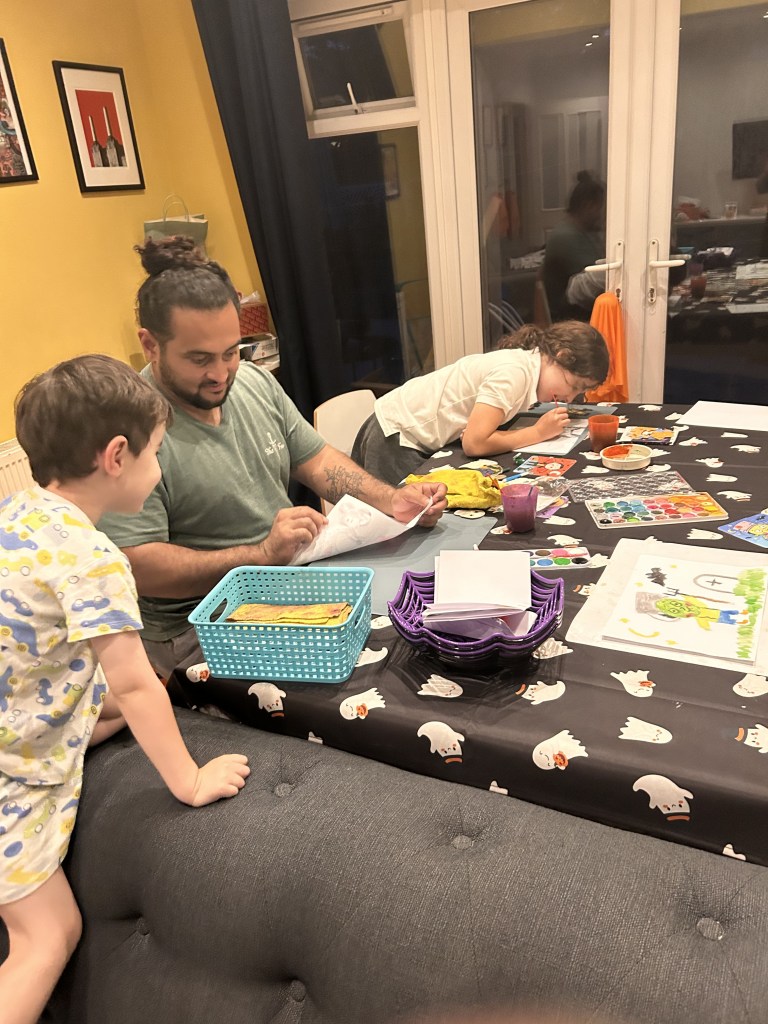
One evening, the three of us sat down to do some Halloween painting.
River refused to join in. Obviously.
There was crying, protesting and a fair amount of outrage at the suggestion that we might all sit around a table and enjoy ourselves.
So we just got on with it.
We all painted, chatted and generally ignored the protests. Every so often River would wander over to investigate, but the moment we suggested he join us, he’d disappear again.
Eventually, he came and sat right next to me.
He wasn’t going to paint, let’s not get carried away, but he was more than happy to direct me on exactly which colours I needed for my zombie picture.
And right at the end, he even mixed some of the paint himself.
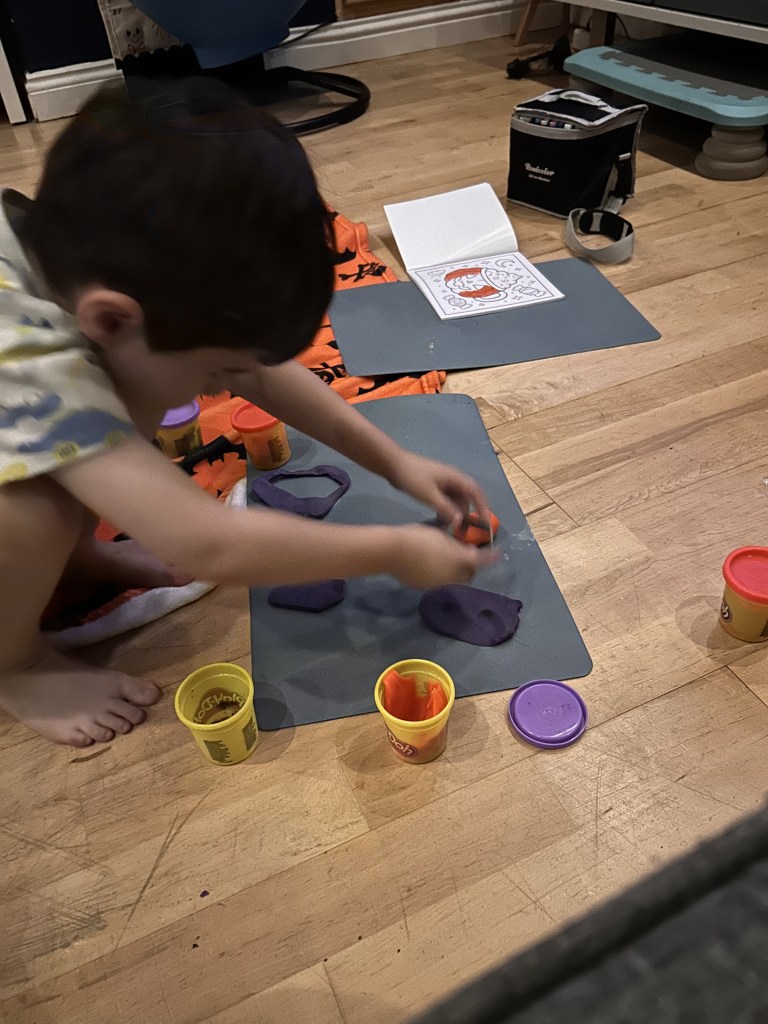
The following day was playdough monsters.
Once again, River had absolutely no intention of joining us at the table.
Summer asked if she could use her playdough mat on the floor instead. I couldn’t see any reason why not, so down she went.
Well, River thought this was an excellent idea.
He fetched his own mat, settled himself on the floor beside her and proceeded to make a delightful little row of purple coffins.
No tears. No persuasion. No carefully planned intervention.
Just two children making Halloween things on the floor.
And it made me think about everything I’d been learning over the last few weeks.
All the sensory information, the executive functioning, the expensive equipment and the endless strategies.
Sometimes the answer is simply to change the environment, remove the pressure and let him find his own way in.
I’m not suggesting it’s always that easy. Believe me, I wish it were.
But these little moments remind me that progress doesn’t always look how we expect it to.
Sometimes it’s five minutes on a classroom carpet with a packet of Quavers.
Sometimes it’s mixing one tiny bit of paint.
And sometimes it’s a perfectly organised row of purple playdough coffins.
So perhaps I need to spend a little less time worrying about everything that isn’t working and a little more time enjoying the things that are.
Because while knowledge might be power, sometimes a bit of Halloween nonsense is exactly what we need.


Leave a Reply