
Last night, Kike and I stayed up watching trash TV and I stupidly had a whisky and coke. Who do I think I am? Don Draper. This morning, I did not feel well. But it was Summer’s day out, so there was no time to wallow. I was taking her to the theatre to see Barmy Britain: A Horrible Histories West End performance, with one of her close friends and a good friend of mine. Kike decided he couldn’t take River to the gym, so he worked from home and had a boys’ day instead.
The show was brilliant. Just two actors but so talented, taking us on a whirlwind through the history of Britain – from the Romans right through to the Victorian night soil men (who, delightfully, collected people’s poo). Summer laughed the whole way through, and we capped it off with her traditional McDonald’s treat after the theatre. Meanwhile, the boys had their own feast – pizza for lunch. River had been demanding it since he woke up. The afternoon slipped into a lazy haze, so lazy that River actually fell asleep again. I took the opportunity to catch up with some TV. I’m Team Conrad (and if you know what that refers to then don’t judge me, yes I’m a 41 year woman who likes coming of age girl shows) We ended with a movie night, keeping that chilled vibe going.
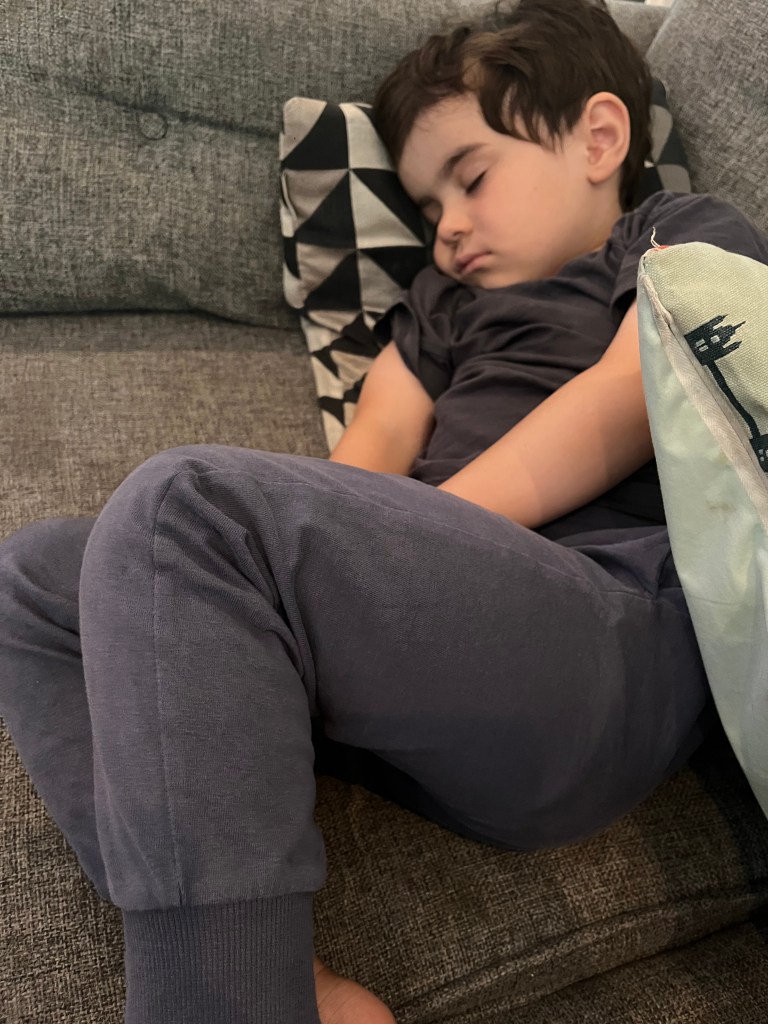
When Words Came Late
A few people have commented recently on how much River’s speech has improved over the summer. It’s been one of the most noticeable shifts, especially for those who haven’t seen him in a while. I still remember how it began, or rather, how it didn’t. He didn’t speak before he was two and when words finally did come, they weren’t the “mumma, dada, car” you might expect. Instead, one of his first words was him counting to five and of course the word no. He really does love that word.
We were told he was speech delayed and went to see a speech and language therapist. As the words built up, we realised many weren’t ‘functional’ words for communication at all. They were borrowed: scripts from TV, or repeated phrases he’d heard from me. It took over three years before I earned a label from him. And even then, I wasn’t “mummy.” I was “Hey Babe.” Every evening when Kike walks through the door, he gives me a kiss and says, “Hey Babe.” So naturally, that’s who I became.
Scripts, Songs and the Alphabet
Once we tuned in, we started noticing his little scripts everywhere. Theme tunes repeated. Catchphrases recycled. Halloween songs on a loop. He adored the alphabet, too – not just the letters but the YouTube-style versions where each letter comes with a word. His favourite was Halloween ABC.
“A – Alien, B – Bat, C – Candy…”
One day, I forgot the “K.” I sang “K – King.”
“NO!”
It had to be “K – Kiss,” or I wasn’t allowed to continue. He knew every letter, every word, in order. If I skipped one, I had to start the whole song again.
That was when we were introduced to the idea of Gestalt Language Processing (GLP). Instead of building language one word at a time, gestalt learners acquire larger “chunks”- phrases, sentences, scripts and gradually deconstruct them into smaller parts. Delayed echolalia is common: repeating phrases they’ve heard, often from TV or stories. For River, it’s his way of expressing a feeling or a need.
Guessing Games and “Speaking River”
This is where the fun guessing games began. On the plane:
“I want to get off the mountain.”
He meant: I want to get off the plane.
Or: “Waah, baby crying.”
Which usually meant: I’m sad, I need a hug.
For months he’d say: “It’s time for an adventure” lifted straight from Andy’s Dinosaur Adventures whenever he wanted to go somewhere.
We also learned that River doesn’t like questions. They overwhelm him. If you ask, “Would you like the red car?” he won’t respond. If you simply say, “River have the red car,” he’ll either say yes, no, or take the car. During a meltdown, questions are like pouring fuel on fire. “What happened? Are you okay? Do you want…?” all of it makes things worse.
Next time you’re talking with a child, count the amount of questions you use. Hello, How are you? What’s your name? How old are you? What would you like to play? Are you hungry? What would you like?
No wonder, River tends to walk off and not respond.
So we learned to strip our language back. Short, ungrammatical sentences – zero questions. In a musical, sing-song voice.
“River hungry. Eat dinner now.”
“River is sad, he wants Summer’s toy.”
“River put shoes on.” (Still rarely works)
And slowly, by speaking his way, he started speaking more. The more we removed the pressure of questions, the more he repeated phrases, created scripts and began shaping his own.
The Fascination of Language
As an educator, I’ve found the whole process fascinating. Most of my career has been spent teaching early years and specialising in phonics. I love teaching children to read, watching them build sentences one block at a time. But River is doing something entirely different.
For most children:
Car → Red car → A red car.
For River:
“The red car is very fast, it zooms round the track.”
He doesn’t yet understand the meaning of every individual word but he’s found a script that matches the object in front of him. And that, in its own way, is incredible.
We often say now that we all “speak River.” It’s a family language. And I know that’s helped him enormously. We’ve stopped trying to force our style of communication onto him. We meet him where he is. As he heads back to school, I hope his bank of scripts will be enough to let him share what he needs. He doesn’t talk there as much as he does at home but perhaps, with time, his voice will grow louder.
Grateful for His Words
Tonight, as I watched him shouting during movie night, it struck me just how far he’s come. There was a time when silence weighed heavy in our house, when we wondered if words would ever come. Now they tumble out: sometimes borrowed, sometimes scrambled, and even recently some of his own.
I feel so grateful for every word. I know some parents are still waiting to hear their children’s voices and must find different ways to communicate without using words. Grateful, too, for the chance to learn alongside him – to unpick language in a way I never imagined. To teach by deconstructing instead of building. It’s changed not just how I understand him but how I see language itself. There is never just one way of learning.
Speaking River is messy, unpredictable and at times frantic but it’s also magical and can be very entertaining. And I wouldn’t trade it for anything.


 50 days of River
Leave a reply to Mark Cross Cancel reply